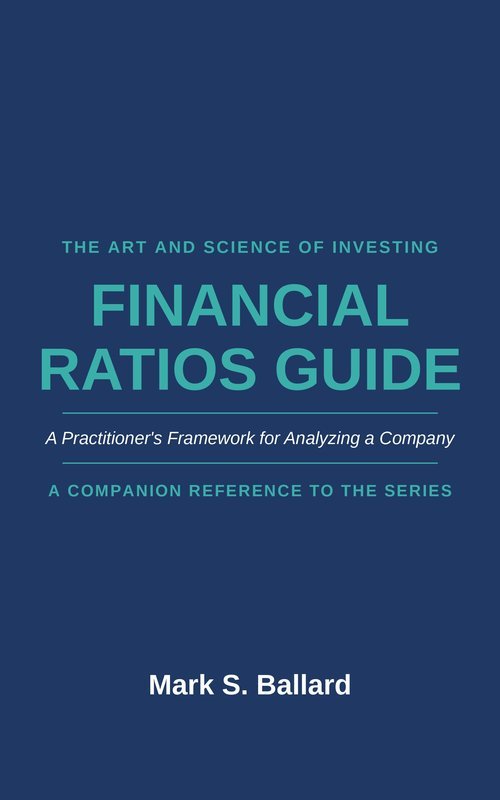
Every buy-or-avoid decision comes down to a handful of numbers pulled from the financial statements. The trouble is knowing which handful, what level should worry you, and when a ratio is quietly lying to you.
That third part is what this guide is for. Any website will give you the formula for interest coverage. What it won't tell you is that a reading above 3.0 is comfortable, above 5.0 is excellent, and below 2.0 means the company is one bad quarter from an interest problem, or that a utility and a software company should be held to different numbers. The guide carries the thresholds and the failure modes, because those are the parts that take years to learn and the parts that actually decide the trade.
How it's organized
Seven categories, each answering one question about a business.
Valuation. What am I paying? P/E, PEG, EV/EBITDA, price to free cash flow, free cash flow yield, and the rest, each with the context that makes a number cheap or expensive.
Profitability. How good is the business? Margins, return on equity, return on invested capital, and the ROIC-against-cost-of-capital test that separates a company creating value from one that merely reports profits.
Growth. Is it getting bigger, and can it afford to? Revenue and earnings growth, the sustainable growth rate, and the Rule of 40 for companies that don't have earnings yet.
Financial health. Can it survive a bad stretch? Current, quick, and cash ratios; debt to equity and debt to assets; interest coverage; cash flow to debt; dividend payout.
Efficiency. How well is the operating engine run? Asset, inventory, receivables, and payables turnover, and the cash conversion cycle.
Cash flow. Is the money real? Free cash flow, free cash flow to sales, and the cash-versus-earnings comparisons where most accounting trouble first shows up.
Risk-adjusted return. Was the return worth the ride? The measures that put volatility and drawdown next to performance.
Each entry gives the formula, what the ratio measures, why it matters, the acceptable and desirable levels as I use them, and the situation where it breaks. The last part is the one I'd pay for. Slowing inventory turnover paired with rising inventory is an early warning of softening demand, often before it shows anywhere else. A declining receivables turnover with receivables rising means the company may be loosening credit to chase sales. A payout ratio over 100% means a dividend is being paid out of something other than earnings. Those are the patterns the guide exists to make routine.
Every ratio is a tool for comparison, not a verdict on its own. A P/E of 25 is expensive for a slow-growing utility and cheap for a fast-growing technology company.
What's in the back
Two frameworks and a workbook. The takeover-candidate screen runs seven independent cheapness tests together and flags a name worth deeper work when four or more pass. The quality rating is a seven-metric, hundred-point weighted score, with ROIC against cost of capital weighted heaviest, mapped to a letter grade; it's offered less as a formula than as a template for building your own.
Then the case-study workbook: a hundred-question exercise, fifty story problems, and a full company analysis that takes a fictional firm through every category in order. The workbook is there because reading a ratio's definition and recognizing it in a real set of statements are different skills, and only the second one makes money.
How to actually use it
Don't try to memorize it. In practice I lean on a handful for any given piece of analysis: ROIC, ROE, margins, debt to equity, and interest coverage for quality; P/E, PEG, EV/EBITDA, and free cash flow yield for valuation; revenue growth, earnings growth, and sustainable growth for growth. The rest are there for when a specific question comes up, which it will.
Keep it next to the computer, not on the shelf. It's 8.5 by 11 for that reason. When you're working through a 10-K and a number looks odd, the guide is where you check what odd means for that industry, and whether the odd number is a reason to keep reading or a reason to stop.
Who it's for, and who it isn't
It's for the reader of Book One who wants the full toolkit in one place rather than spread through the chapters, and for anyone who already analyzes companies and wants a second opinion on thresholds from someone who used these numbers to manage money for four decades. The guide is also the reference the staff training program at my former bank is built on, so it has been tested on people learning the job.
It isn't an introduction. If you don't yet know what a balance sheet is, start with the opening of Book One, which is free here, and come back. And it won't give you a verdict; every number in it is backward-looking and tells you what already happened. The judgment you bring to the ratios is what makes it investing rather than arithmetic.
The specifics
- Full title
- Financial Ratios Guide: A Practitioner's Framework for Analyzing a Company
- Format
- Paperback
- Trim size
- 8.5 by 11 inches, so it lies flat next to a keyboard
- ISBN
- 979-8-952342-02-6
- Goes with
- Book One, Fundamental Analysis, whose ratio chapter it expands into a full reference
- Where to buy
- Amazon
Three of the ratios get their own free articles on this site, if you want a sample of the approach before buying: free cash flow, the PEG ratio, and intrinsic value, which is where the ratios eventually lead.
Built from Book One.
Book One, Fundamental Analysis, teaches the method: the three statements, the ratios that matter most, and the growth-at-a-reasonable-price screen. The guide is the full toolkit, organized for use mid-analysis rather than read once. Buy them together, or start with the guide if you already know the method and want the reference.